—— THE LEAP · FOR PHOTOGRAPHERS WHO WANT MORE OF THE RIGHT CLIENTS ——
Not enough bookings.
No idea what to fix.
You've tried posting more. You've tried a new offer. Something worked once and you can't tell what. Hire Your Data Analyst finds out where your clients actually come from and what each one's worth, so you stop guessing what to fix and start doing more of what works.
Hire Your Data Analyst
Find the money hiding in your own business.
£99 · one-off · works on Claude's free plan
Secure Checkout Via Podia, instant access
—— What an AI Analyst does ——
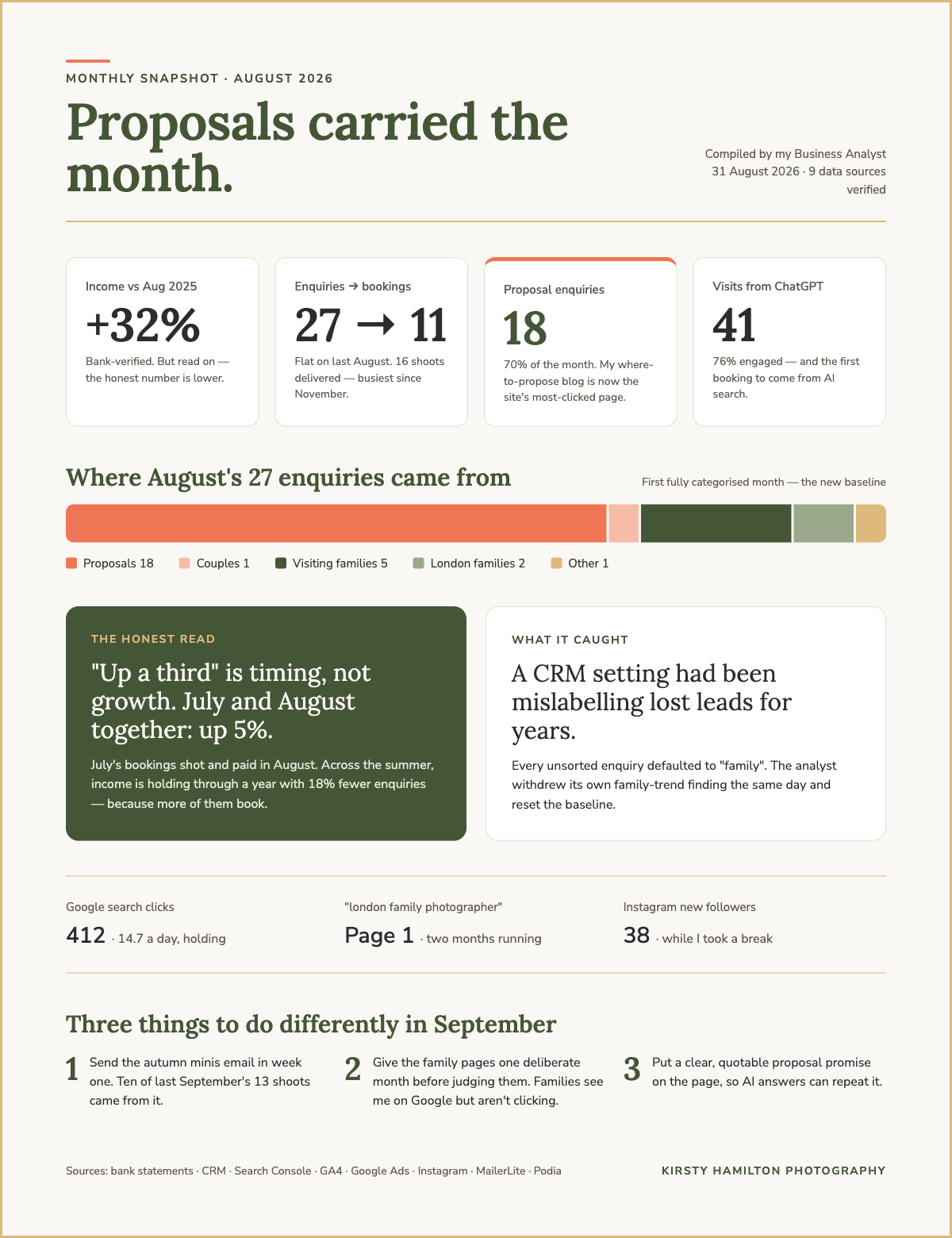
This is what a month looks like when someone's reading your numbers.
My analyst's snapshot for August 2026.
Income up 32% on last August, and in the same breath the honest read: up 5% across the summer, enquiries down 18% on the year.
Eighteen of my twenty-seven enquiries were proposals. Forty-one visits from ChatGPT and the first booking that came from one.
And the mistake it caught in its own numbers, and withdrew the same day.
All I need to do is give it three files. This is what comes back.
—— Same business. Different July ——
One proposal booking last July. Eight this July.
In June, my analyst spotted that proposal shoots were becoming my most valuable clients, and that the interest was arriving through Google, not Instagram.
So I moved my effort to where the enquiries were coming from: the proposal page, new proposal blogs, optimising the website rather than more instagram posting.
Last July, one proposal booking. This July, eight (and see above for what happened in August).
Same month. Same me. The difference was knowing my numbers and acting on them. (One strong month is a signal, not a trend.)
Secure Checkout Via Podia, instant access
—— Fantastic Mentor ——
“Kirsty is a fantastic mentor. I’d highly recommend her to anyone looking to improve their business skills.”
— Mona N, September 2026 —
—— The Problem. Done differently ——

Here's a confession
I set up Google Analytics and Search Console on my website in 2018.
Two free tools, collecting the whole story of my business: who was finding me, how, and what was working.
And in seven years I never looked at any of it. Not once, properly.
Because I'm a photographer. I want to be out shooting.
And sitting down with the data meant first learning what I was even looking for.
So I ran my business on instinct instead.
Until my website fell off page one of Google, my enquiries dried up, and I found out the warning signs had been sitting in that data the whole time.
I still haven’t become a numbers person…
I hired one instead.
Ok, fine NOT a person. A Project inside Claude, with a job description, a memory and a standing set of instructions about my business.
It reads what I give it.
It measures this month against my own baselines.
It tells me what's up, what's down, and what to do.
And it checks its work, because I taught it to.
Ten minutes a month. That's the whole habit. I've run it every month since, and it's the reason the page you're reading exists.
Secure Checkout Via Podia, instant access
—— How it works ——
Three steps. A weekend, then ten minutes a month.
1
PROTECT, THEN HIRE. A five-minute privacy check and a thirty-second routine for stripping names out of every export, so your clients never go anywhere near an AI. Then the Analyst Builder interviews you about your business, one plain-English question at a time, and writes your analyst's instructions for you.
2
FEED IT. Your bank statements, invoices and booking history go in (patterns, not people). Your analyst reads them and works out your baselines: what you earn, what each type of client is worth, where your work comes from. This is the big pass; give it an evening or two.
3
ASK IT MONTHLY. Export day, the privacy check, give it the files, let it analyse your data. Ten minutes later, a one-page snapshot and three things to do the next month. You sort out your marketing plan and focus for the next month. Then go back to shooting or literally anything that is more fun than business admin.
Secure checkout via Podia · Instant Access
—— What you get ——
Inside Hire Your Data Analyst
Twelve lessons, thirteen short videos and eleven PDFs, in order, at your own pace.
They take you from protecting your data privacy and that of your clients, through hiring and feeding your analyst, to the lesson that makes the rest safe (checking its work, with a real number of mine that collapsed the moment I checked it), then the three questions worth asking: where the work comes from, what each client is really worth, and which of your marketing is paying. It ends with your monthly rhythm and how to teach your analyst your calendar, so it tells you what next season needs now.
Also included:
The Analyst Builder. The guided interview that sets up your analyst and writes its four working documents: its instructions, your data schedule, your first-load brief and your monthly report format. All personalised to what you sell and the systems you have.
The Get Connected Cheat Sheets for Search Console, Google Analytics, Instagram insights, your booking system and Google Business Profile.
plus The Protect Before You Start checklist and the never-upload list (PDF) so your data is secure and private.
Secure checkout via Podia · Instant Access
—— Sound Familiar? ——

You know your business. You just can't see it.
You couldn't say, hand on heart, what your average booking is worth. Or which type of client is worth the most.
You think you know where your enquiries come from, but you've never actually counted.
You've got Google Analytics and Search Console switched on, and you haven't opened either in months. Maybe years OR you don’t know what those are or how they can help your business (we’ll get you connected and collecting valuable data in no time!)
Every marketing decision starts with "I feel like..." and you're a bit tired of feeling.
And a small voice wonders whether the business is doing as well as it seems, and would rather not find out.
If that's you, the fix isn't a spreadsheet course. It's getting the reading done by something you've hired to read, and keeping the decisions for yourself.
Why an analyst, and why in a Project
Paste your numbers into a chat and it's gone when the chat is. You'd re-explain your business every time and get answers about some average photographer. Build your analyst in a Project and it keeps your baselines, your standing rules and your report format, so every month is measured against YOUR business.
And it's taught to doubt itself because AI can make mistakes. Early on, mine found what looked like a hidden revenue stream worth a big chunk of my turnover, that didn't sound like something I'd miss. I checked it against my invoices and the whole thing collapsed into double-counted bookings. That's why there's an entire lesson on checking its work. The analyst that can't say "I was wrong" is the dangerous one. You stay the editor.
Secure checkout via Podia · Instant Access
—— Is this for you? ——
For any photographer who wants a better business. Fully booked or could be busier.
You're a year or more into running your business and you want more clients. You've tried things, some of them worked, and you couldn't say which.
Your analyst finds out where your bookings actually come from and what each type of client is worth, so the next thing you try is the thing most likely to work.
OR you’re run off your feet and flat out with bookings. I've been fully booked all summer, and I'm exhausted.
I need my analyst more than ever: to show me where I'm throwing effort at work that doesn't reward me, and where the profitable bits are that I should be doing more of. Busy isn't the same as profitable. A good year is exactly when you find out which one you are.
Either way, all your analyst needs is data: business bank statements, invoices and bookings to read.
Whether you shoot families or weddings, newborns or headshots, dogs or brands. A big city or a village, the UK or anywhere else, this course can benefit you.
Not there yet? If you're just starting out and don't have six months to a year of records, wait on this one. You'd be building an analyst with nothing to read.
Start with Launch Ready, where I show you how to capture the right information and build a strong business foundation, from your very first client. Come back to this once there's a good run of paying clients behind you.

£99 · one-off · works on Claude's free plan
Secure checkout via Podia · Instant Access
—— Where this road goes ——
Imagine the first Monday of the month
You make a cup of tea, export three files, and drop them into Claude.
Ten minutes later, your snapshot is in. Enquiries up a little. Your average booking creeping the right way. One type of client worth far more than you'd assumed, and a note that most of them found you through Google, not Instagram.
Three things to do this month. Not thirty. Three.
So you stop pouring evenings into the channel that isn't paying, put an hour into the one that is, and go back to shooting.
That's where this road goes. Hire Your Data Analyst is where it starts.
Secure checkout via Podia
—— Before You Ask ——
Great Questions, Honest Answers
-
Hire Your Data Analyst is a self-paced online course that shows photographers how to set up their own AI data analyst inside Claude, trained on their own business records, so it reads the numbers for them. You come out with your real baselines (what you earn, what each type of client is worth, where your work comes from) and a ten-minute monthly habit that tells you how your business is doing and the three things to do about it. It's taught by Kirsty Hamilton, a London family photographer and former journalist, exactly as she runs it in her own business. There are twelve lessons, thirteen short videos and eleven PDFs, and it costs £99.
-
No. That's the whole point. You won't learn spreadsheets, formulas or a single piece of jargon. You set up an analyst that does the analysing, and your job is to ask it questions, check its answers and make the decisions. If you can export a report from your booking system and paste a message into Claude, you can do this.
-
It's a Project inside Claude with a permanent job description and a memory. You tell it once what your business is, what you sell, which systems you use and what you want to know. From then on it remembers, so every month you drop in your latest numbers and it reads them against your own baselines, rather than you re-explaining your business to a stranger each time. Think of it as a team member you hire, brief and manage, not a magic wand.
-
No. The course runs inside Claude, and it works best on a paid plan, but you can complete it on the free plan too. Free accounts can create Projects, so you can build and run your analyst without paying a penny. What you'll notice on the free plan is shorter sittings and a slower pace through the first big load of data; the monthly check-in is a short session by design and works on any plan. I'll show you exactly what's different so nothing catches you out.
-
Photographers who are already booking clients and ideally have at least a year of bookings behind them, whatever they shoot and wherever they are: families or weddings, newborns or headshots, dogs or brands. If you've been making marketing decisions on instinct because the numbers feel like someone else's job, this is built for you. If you're brand new and don't have a year of records yet, start with Launch Ready instead, where I show you how to capture the right information from your very first client.
-
Yes, and I'd say that as someone who's been fully booked all summer. A full diary tells you nothing about which bookings are worth the most, which marketing is paying and which is just keeping you busy, or whether the bank balance matches the effort. Your analyst shows you where you're spending energy for little return and where the profitable work is, so a busy year turns into a better-paid one instead of just a tiring one.
-
Less than you think. Your bank statements, your invoices and your booking system's history work from day one, and they're most of what the first load needs. If you haven't switched on Google Search Console or Google Analytics yet, that's completely normal (I hadn't looked at mine properly in seven years) and there are step-by-step cheat sheets to get them connected in week one, so they're collecting while you work.
-
You won't. The very first lesson is about protecting your clients before you upload anything: the privacy settings to check, the list of things that never get uploaded, and a thirty-second routine for stripping names, emails and phone numbers out of every export. Your analyst needs the patterns, not the people. Anything that goes into a Project stays available there, which is exactly why the strip happens first, every time.
-
It's a fair worry, and the course takes it seriously before you upload anything. First, you strip every export before it goes in: names, emails, phone numbers and account numbers come out in a thirty-second routine, so what your analyst sees is dates, amounts and categories, not people or account details. Second, the very first lesson walks you through the privacy settings in Claude, including switching off the setting that would let your conversations be used for training, so your business stays your business. Third, your analyst lives in a Project you control: you can delete anything in it, or the whole thing, at any time. And you never hand over your bank login. You export a statement yourself, strip it, and upload the file, the same way you'd send one to your accountant.
-
Give it a weekend, or a few evenings spread over a couple of weeks. The lessons themselves are short, most under seven minutes, and the Analyst Builder interview is a sitting of an hour or so. What takes the time is the real work around them: connecting Search Console and Google Analytics if you haven't already, exporting and stripping your files, and the first load, where your analyst reads your records and works out your baselines. That first load is the big one, and it's slower on the free plan. After that it's ten minutes a month, and it's fully self-paced, so nothing needs doing in one go.
-
Your real baselines first: what you typically earn in a month, the average job value for each type of client, how many enquiries turn into bookings, and where your work actually comes from. Then, every month, a one-page snapshot measured against those baselines: what's up, what's down, what it can't see yet, and the three things to do about it. It's how I spotted that proposal shoots were becoming my most valuable clients, and it's how I went from one proposal booking last July to eight this July.
-
Not blindly, and the course teaches you not to. AI analysis can be confidently wrong, and the first time it hands you an exciting number is exactly when you check it twice. There's a whole lesson on checking its work, using a real finding from my own business that collapsed the moment I reconciled it against my invoices. You stay the editor. The analyst does the grunt work; you decide what's true.
-
It's a weekend's work once, then ten minutes a month. I ran my business on instinct for years because sitting down with the data felt like a job I'd have to learn first. This takes that job off your plate. The effort is small; the thing it stops you doing, which is guessing, is what costs you.
-
It's the opposite. This is the thing that tells you which of your marketing is paying and which is just keeping you busy, so you can stop doing the bits that aren't. There's nothing to post, no platform to feed. Ten minutes a month, and a clearer head for the other twenty-nine days.
-
Then you'll know, and knowing is the whole point. A machine reading your numbers has no judgement in its voice, which makes this a much kinder way to face them than a spreadsheet and a sinking feeling. Every snapshot ends with three things to do, so you're never left with bad news and no next step. The warning signs for my own drop off page one of Google had been sitting in my data for months. I'd have given a lot to see them earlier.
-
Memory and method. A chat forgets your business the moment you close it, so you'd re-explain everything every time and get generic answers. Your analyst is built once, with your baselines written into its instructions, standing rules for how it checks its work, and a report format that ends in three actions. It compares this month to your business, not to some average photographer.
-
Yes. Nothing in the method depends on where you are or what you shoot. Your analyst is built from your own records, so it learns your seasons, your client types and your marketing channels. My examples come from my London photography business, but the method has no postcode.
-
Twelve lessons, thirteen short videos and eleven PDFs, plus the Analyst Builder, the guided interview that sets up your analyst in a single sitting and writes its instructions, your data schedule, your first-load brief and your monthly report format, all personalised to your business. You also get the Protect Before You Start checklist, the Get Connected cheat sheets for Search Console, Google Analytics, Instagram insights, your booking system and Google Business Profile, the checking-its-work checklist, and the seasonal-pattern sheet that teaches your analyst your calendar.
-
For as long as the course is live, with every update included. I don't promise lifetime access on anything, because I've been promised it myself and watched courses vanish, and because the AI tools change fast enough that a course frozen in time isn't worth much. I'd rather keep this one current and give you the updated version each time.
-
Yes, and no. Hire Your Data Analyst is one part of Kirsty Hamilton's twelve-week live programme for photographers, Finally Found and Actually Booked, which starts in January 2027. But it's complete on its own, and you don't need the programme to get the value from it. From the month it's built, your analyst reads your numbers, tells you where your work comes from and what each client is worth, and gives you three things to do. That's the whole job, and it's done. The programme is a different thing: a look at your whole business and the whole of your marketing, from getting found on Google and by AI, to your numbers, to a content system that markets you on purpose, with me and a small group working through all of it with you over twelve weeks. Your analyst is one of the courses inside it. If you only want the analyst, this is the course, and it's all you need.
-
It's a digital course with instant access, so once you're in I can't refund it, which is the same on every Podia course. That's why the who-it's-for section is honest about who should wait. If something's gone wrong with your access, email me and I'll sort it.
—— In case we haven’t met yet ——
Hi! I’m Kirsty
For fifteen years I was a journalist. I knew how to write words that made people act; what I didn't know was how to make that career fit around two small children.
So at 34 I quit, picked up a camera (in desperation, because being a stay at home mum felt incredibly isolating), and realised I’d found my new passion. I’ve spent a decade figuring out how to get clients, how to get found on Google, and how to build a business that bends to my family instead of against it.
Over a thousand shoots later, it does.
Then, in 2026, I went through nine years of my own business data and found out what was actually true. Where I was winning clients and where I was losing them. And (most importantly) how my business was doing in real time so I could market accordingly.
And I’m passionate about seeing other photographers succeed in the same way.
A brilliant, profitable photography business isn’t something that happens to lucky people, it’s something you can build yourself, and I have the tools to help you do it!