A Family Found Me on ChatGPT. Here's What My Website Said.
Yes, ChatGPT can send you photography clients. It sends me clients all the time. In this particular instance, it sent me a dad wanting to book a surprise photoshoot for his wife, but he was worried how his toddlers would handle the whole experience.
The dad didn't type "family photographer London" into Google. He asked ChatGPT to recommend a photographer who was good with small children, because he had two of them: toddlers, at that tricky stage, where meltdowns are frequent and snacks are a lifeline. ChatGPT suggested me. He sent an enquiry from my website, then picked up the phone and told me exactly how he'd found me.
So this is ChatGPT SEO from the photographer's side: what he asked, what my website said, and what I'd tell any photographer who wants to be the answer when their clients ask an AI assistant to recommend someone.
Can ChatGPT really send you photography clients?
Yes. When someone asks ChatGPT to recommend a photographer, it can name real businesses, and it named mine. The enquiry came in with ChatGPT logged as the source, and the dad confirmed it himself when he rang me.
What it matched him to was the plain description of how I work with toddlers, written on my own website. Which means it's something you can do too.
What do people actually ask ChatGPT when they're looking for a photographer?
Here’s what they DON’T do: They don't ask it for a photographer in the same way they’d type a question into Google. That's the biggest lesson from this booking.
On Google, people search in fragments, keywords and short phrases: "family photographer London", "London family photoshoot". On ChatGPT, they talk. They describe their situation in a whole sentence and ask for help, the way they'd ask a friend.
This dad's situation was two toddlers who were never going to sit nicely for a camera. So that's what he asked for: a photographer who was good with small children.
I checked Google's own keyword data, and Google searches for "photographer good with kids" or "family photographer good with toddlers" barely exist. There aren't enough of them for Google to report a number at all.
So if I'd only ever written my website for Google keywords, nothing would have matched his question about someone who is good with children. The question that brought me this booking hardly exists as a Google search. It exists as a conversation.
What did my website say that ChatGPT picked up?
First, the honest bit. I don't know exactly what ChatGPT told him. I didn't see his screen, and ChatGPT can give two people two different answers to the same question AT THE EXACT SAME TIME. So I'm keeping three things separate: what he asked, what my website says, and what I see when I test ChatGPT myself (that's further down).
Here's his enquiry, the one he wrote on my website form enquiring about a photoshoot in London, word for word:
"Nothing crazy, kids probably won't do poses and are intermittently uncooperative."
And here's my family page, word for word:
"I know toddlers aren't keen on sitting still and smiling on command, so I don't ask them to."
Read those two together. He described his problem in plain words, and my page described the answer in plain words. Neither of us used a keyword.
I didn't write that line for ChatGPT. I wrote it because it's true, and because it's what every parent of a toddler worries about before they book me. There's a whole section of that page about being brilliant with children, and it ends with "The wriggly ones are my favourite." He was visiting London, and my tourist page says the same thing in its own way: pram-friendly routes, snack stops built in, "Wriggly toddler?"
That's the part I'd underline for any photographer. What matches you to a question like his is a plain, true description of what you're good at, written in the words your clients use about themselves.
Did the shoot live up to what my website promised?
This is why the story matters more than the enquiry. ChatGPT can match you to a client. It can't do the shoot for you.
Before he booked, the dad asked me straight out: "Do you think you can handle them?" I reassured him: A decade of photographing families. Of course I could.
They'd walked across town with the buggy to meet me. Half an hour, on a blazing sunny morning, and nobody had eaten breakfast. The one-year-old arrived sad and would only be held by Dad. The eldest hid behind Mum's legs.
I got ONE frame of all four of them together by the river, and then it all went downhill.
So I stopped asking for anything. No smiling, no "look at me". Dad went for snacks, I handed out stickers, and while the kids sat in the buggy I photographed Mum and Dad on their own.
Then we moved on to the park, with squirrels promised and biscuits handed out. Mum and the eldest ran at me laughing, Dad threw the little one in the air, and every good frame of that lasted exactly sixty seconds. Then we had another meltdown. So I called it.
They apologised. I told them I knew it had felt like a nightmare, but amid the chaos, we got the photos, the small moments where they actually forgot I was there and that they were safe and loved, in the arms of their parents. Of course I felt a little nervous when I sent the gallery! I wanted them to see what I saw through my lens, how much their little ones are loved, how beautiful they are all together.
As soon as the gallery landed, Mum messaged: "I love them sooooo much!!!" And then came the review:
"Kirsty was absolutely wonderful! She was incredibly friendly, patient, and so talented. We had two toddlers who were definitely not making her job easy, but she handled all of the chaos with such patience and kindness and somehow still managed to capture the most beautiful images of our family."
That's the job. And it's the promise my website made, kept.
The same review says I have "a real talent for capturing beautiful, natural moments, especially with young children." That's my website's claim again, this time in a client's own words.
And what your clients say about you is part of the picture that AI tools build of your business, alongside what you say about yourself.
How do I rank on ChatGPT as a photographer?
First, a small reality check on the word "rank". ChatGPT doesn't give you a position on a page the way Google does. It answers a question, and sometimes the answer names you.
You'll hear the work of making that happen called AI search optimisation, or generative engine optimisation (GEO, which is the marketers' name for it). I call it AIEO, and I've written a whole post on what AIEO is. The labels all mean the same thing: making your business easy for tools like ChatGPT to understand, describe and recommend YOU.
Here's what this booking taught me to do.
Write down the sentence your clients say. Look back through your enquiries and listen properly on your calls. Mine said "intermittently uncooperative". What do yours say?
Answer it on your service page, in plain words. One clear, true line about how you handle that exact worry. Mine is "I know toddlers aren't keen on sitting still and smiling on command, so I don't ask them to."
Make it specific, and make sure you mean it. "Great with kids" could be anyone. "The wriggly ones are my favourite" couldn't. An AI tool is looking for a clear match, and so is a nervous parent.
Put your name next to your numbers. In July I found AI tools crediting my figures to another photographer. Once I'd fixed my site so my name sat in the same sentence as my experience, that stopped.
Let your clients say it too. Ask for reviews. When a client writes about the thing you're good at, your promise gets repeated in someone else's words.
Keep your Google foundations solid. When ChatGPT searches the web, it's reading the same public pages Google can see. Everything in my post on SEO for photographers still applies, and it's the place to start if your website needs work.
How do I check whether ChatGPT recommends my business?
You can do this in five minutes, for free.
Open a private or incognito window and use ChatGPT without logging in, so it isn't working from your own history.
Ask the question the way a client would, in a full sentence with their situation in it (look through your enquiries for inspiration). Here are some examples:
"Can you recommend a family photographer in [your town] who's good with toddlers?"
“I’m looking for a relaxed wedding photographer, someone fun and discreet who’ll capture our wedding day without too many formal photos, I don’t want to spend ages posing for photos. can you help?”
Write down whether you're named, how you're described, and who's named instead. Then ask the same questions, word for word, once a month.
I run five client-style questions like this myself. On 21 July, ChatGPT named me for one out of five. On 31 August, it named me for five out of five. That's a single run each time, logged out, and ChatGPT can answer differently the next time you ask. So I treat it as a direction of travel, not a score to frame. (Although I'd love to frame it.)
And if a real client ever tells you what they asked, add their exact words to your list. It's the best test question you'll ever get.
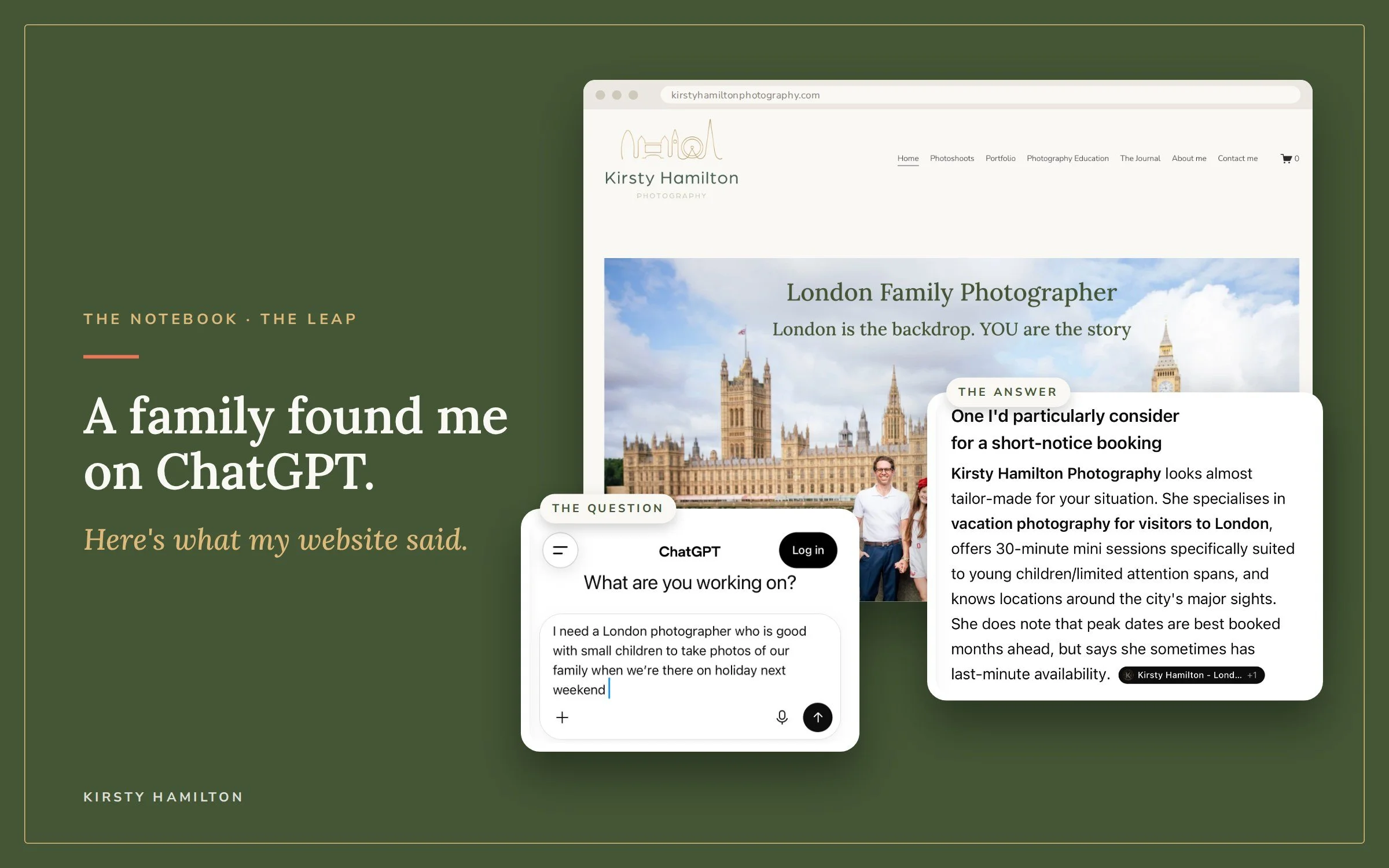
I did exactly that while writing this post, on 11 September. Logged out, I asked ChatGPT: "I need a London photographer who is good with small children to take photos of our family when we're there on holiday next weekend." It named me as the one it would "particularly consider", said I looked "almost tailor-made for your situation", and that I offer "30-minute mini sessions specifically suited to young children/limited attention spans". My family page says: "A 30-minute mini session often works beautifully for the youngest children or shorter attention spans."
That's my own sentence, coming back to me in ChatGPT's words. It's one run and one answer, and it could say something different tomorrow. But it's the clearest look I've had at what ChatGPT reads.
Want to be the answer to your clients' questions?
This family found me because my website said, in plain words, the thing he needed to hear. You can do the same for your business, whatever you photograph.
If you'd like to start with AI search on its own, Get Found by AI walks you through it in six lessons: how AI search behaves, writing client-question FAQs for your website, and a fifteen-minute monthly check so you can watch what changes. It's a standalone course, so you can start there today.
And if you want the whole picture, Google and AI search, your numbers and your content, with me alongside you every week, that's Finally Found and Actually Booked, my twelve-week live programme starting in January 2027. Applications for the founding run close on 31 October.
Either way, if you've got a question about any of this, message me. I'd love to hear what your clients are asking.
Good Questions, Honest Answers
-
Yes. When someone asks ChatGPT for a photographer, it can name real businesses. A family found me that way: the dad asked ChatGPT for a photographer who was good with small children, it suggested me, and he booked. It works best when your website describes what you're good at in plain, specific words.
-
ChatGPT SEO means making your business easy for ChatGPT to understand, describe and recommend when someone asks it for help. For photographers, that mostly comes down to clear, true, specific words on your website about who you photograph and how you work, backed up by reviews and solid Google foundations.
-
No. You can use ChatGPT for free without logging in. Open a private browser window, ask the question the way a client would, and note whether you're named. Ask the same questions once a month to see which way things are moving.
-
There's no fixed timescale, and nobody outside OpenAI can promise one. In my own monthly test, ChatGPT named me for one out of five client-style questions on 21 July 2026 and five out of five on 31 August 2026. That was a single run each time, so I treat the results as a direction of travel.
-
Yes. Get Found by AI is my six-lesson course on getting found in AI search, and you can take it on its own for £99. It's also part of Finally Found and Actually Booked, my twelve-week live programme for photographers, starting in January 2027.
-
This family found me because my website said, in plain words, the thing he needed to hear. You can do the same for your business, whatever you photograph.
If you'd like to start with AI search on its own, Get Found by AI walks you through it in six lessons: how AI search behaves, writing client-question FAQs for your website, and a fifteen-minute monthly check so you can watch what changes. It's a standalone course, so you can start there today.
And if you want the whole picture, Google and AI search, your numbers and your content, with me alongside you every week, that's Finally Found and Actually Booked, my twelve-week live programme starting in January 2027. Applications for the founding run close on 31 October.
Either way, if you've got a question about any of this, message me. I'd love to hear what your clients are asking.